Water Damage Restoration in Marysville, From the First Reading to the Last Repair
Restoration is the whole job after water gets into a house, start to finish. It begins with finding where the water came from and how far it went. Then comes getting it out, drying the house until the numbers say it's dry, and rebuilding whatever had to be cut away. In a Marysville home that might mean a crawlspace on damp ground near Allen Creek, or the drywall under an upstairs bathroom in a newer Getchell house. The steps are the same either way. What changes is how long each one takes, and that's why water damage companies measure before they promise anything.
Mitigation, Restoration, Repair
Three words get used on every water job, and they don't mean the same thing.
- Mitigation is the urgent part, the first few days. The water gets stopped and removed, wet materials that can't be saved come out, and drying equipment starts running. The goal is to stop the damage from spreading.
- Restoration covers everything from the first visit to the finished room, including mitigation.
- Repair is the rebuilding at the end: new drywall, texture and paint, baseboards, flooring and cabinets. It starts only once the house reads dry.
You'll also hear remediation. On a water job, it usually refers to the extra cleaning needed when the water came from outside, like a creek, a ditch or a flooded yard, and carried silt and whatever else was on the ground.
Inspection and Assessment: What Water Damage Companies Check First
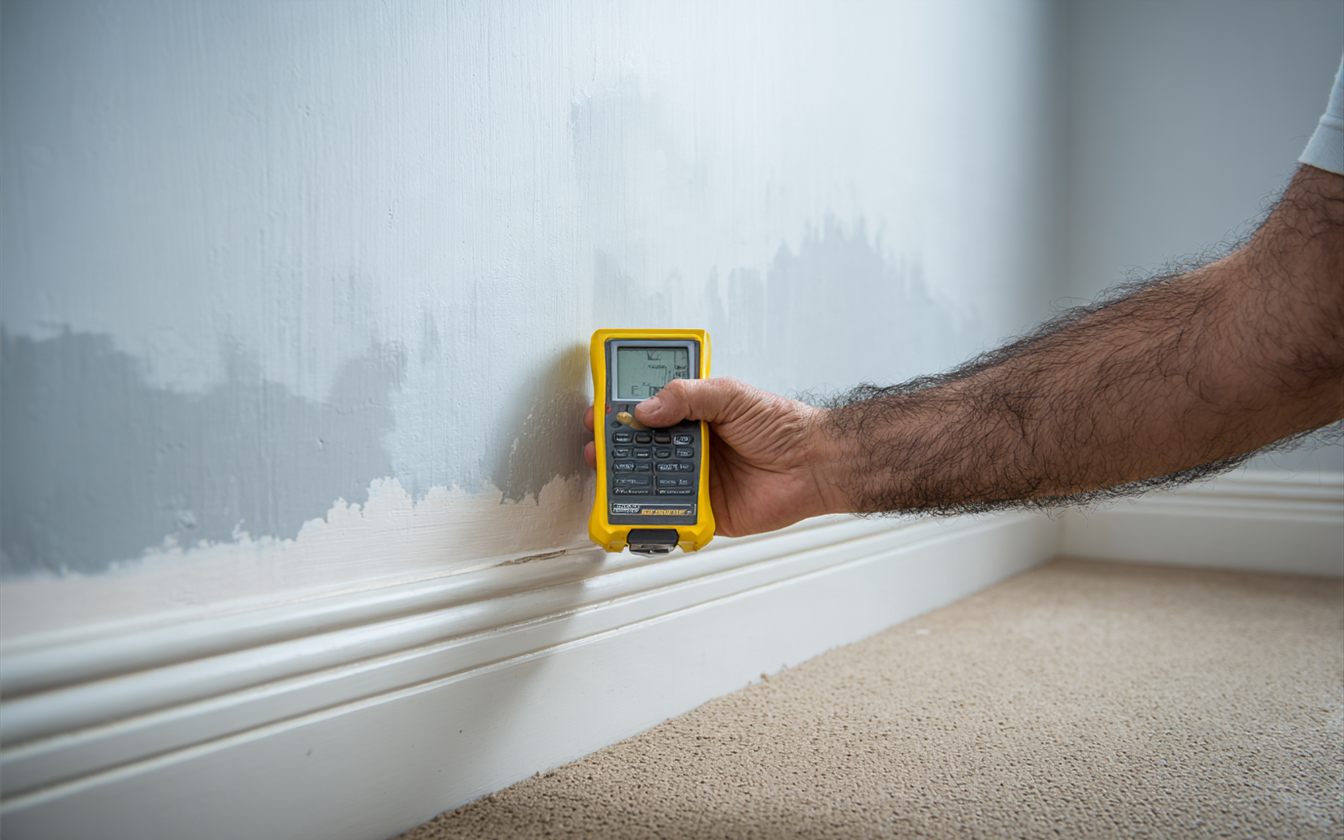
Water damage inspection is a search for wet materials you can't see. Water travels sideways along subfloors, wicks up drywall and runs down inside wall cavities, so the stain you noticed is rarely the edge of the damage. A company that knows its job brings tools to find the rest:
- Moisture meters, pin-type for wood and drywall, pinless for scanning across a floor or wall without leaving holes
- A thermal camera, which shows temperature differences where evaporating water cools a surface (it points to likely wet spots, and the meter confirms them)
- A hygrometer for the air in the room, because drying depends on how much moisture the air can still take
- A look below: the crawlspace under a wet floor, the ceiling under a wet bathroom, the garage wall beside a failed heater
The result should be a map of what's wet, written down, with readings you can keep. More detail: what a water damage inspection looks at.
The Job in Order
- Stop the water. The main shutoff for a pipe or appliance. For outside water, the company works out where it's getting in and what can be done to slow it.
- Make it safe. Power off to wet circuits, and keep everyone off sagging ceilings and out of a crawlspace with standing water.
- Record it. Photos of every wet room before anything moves, and a first set of readings.
- Extract. Pumps for deep water, extraction tools for carpet and pad. Pulling water out as liquid is much faster than drying it out of the air later.
- Remove what won't dry. Saturated pad, swollen particleboard, wet insulation, and drywall that soaked water up past a certain height.
- Dry. Dehumidifiers and air movers sized to the space. In a crawlspace, that can mean drying equipment under the house as well as in the rooms above.
- Measure every visit. Readings logged room by room until the wet areas match the dry reference spots.
- Rebuild. A written list of what came out and what goes back, which is also what an insurer works from.
Drying a House in North County Weather
From October through spring, the air outside in Marysville is usually cool and damp. Leaving doors open "to air it out" lets that damp air in, which slows drying down. Restoration drying works the other way. The house stays closed, dehumidifiers pull water out of the indoor air, and air movers keep dry air moving across the wet surfaces. Crawlspaces add time, especially on lower ground where the soil under the vapor barrier stays wet most of the winter. That's not a reason to wait. Wet framing and insulation only get worse the longer they sit.
What Makes a Job Bigger or Smaller
Nobody can give an honest price for a water job without seeing it. These are the things that decide the size:
- How far it spread. One bathroom floor is small. A leak that ran from an upstairs bath into the kitchen ceiling and the crawlspace is not.
- What got wet. Tile and concrete dry. Carpet pad, laminate, particleboard and insulation mostly get replaced.
- How long it sat. A hose that burst an hour ago is a different job from a drip behind a cabinet for a month.
- Clean or dirty water. Water from a supply line is clean to start. Creek, ditch or yard water brings silt and means more removal and cleaning.
- Whether a crawlspace is involved. Working under a house takes more equipment and more time.
- What's behind the wall. Wiring, plumbing and insulation can all change the plan once a wall is opened.
- The rebuild. Matching texture, flooring and cabinets is often the biggest part of the final total.
How Long Does Drying Usually Take?
It depends on the material and where it is. A clean leak caught early on a slab floor may read dry within a few days. Hardwood, a wet crawlspace or water inside an outside wall takes longer, and winter weather slows it further. A good company keeps the equipment running until the readings say dry, and won't promise a finish date before measuring.
Will the Restoration Company Also Fix What Caused It?
Not usually the cause itself. Replacing the water heater, repairing the roof or regrading the yard is separate work. The restoration company handles the water and everything it damaged: extraction, drying, removal and rebuilding. Ask the company which parts it's covering so nothing falls between two contractors.
Restoration Across North County
Down by the slough
Up on the plateau
Smokey Point and Lakewood
North along the Stillaguamish
- ArlingtonNorth county
- SilvanaNorth county
- StanwoodNorth county
- Warm BeachWest of I-5
- Lake GoodwinWest of I-5
East toward the foothills
- Lake StevensToward the foothills
- Granite FallsToward the foothills
- MachiasToward the foothills
- SnohomishToward the foothills
Water still on the floor? Start with water removal and extraction.