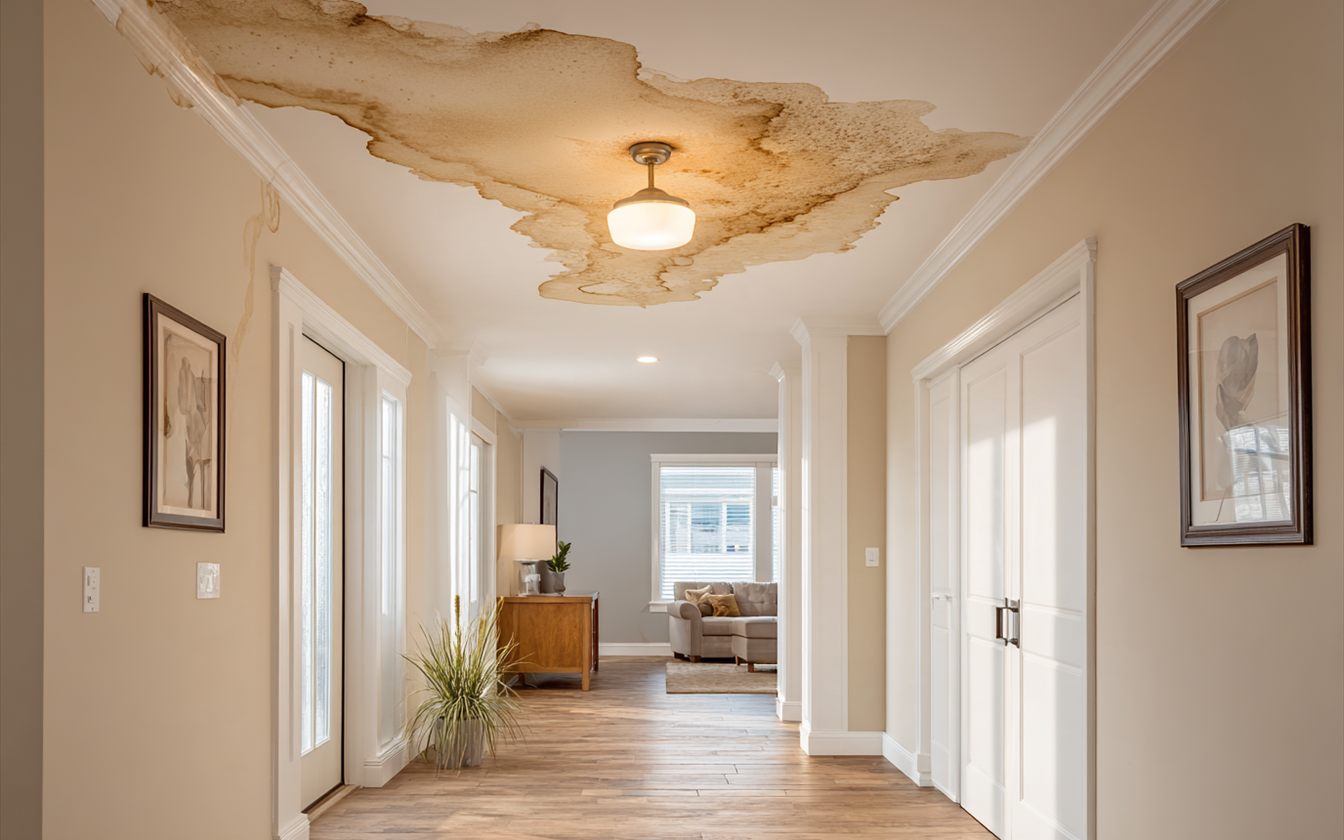
Ceiling and Wall Water Damage in Marysville Homes
A new stain means water has reached the drywall from somewhere. It might be a bathroom or laundry room above, a supply line running through the ceiling, an ice-maker line in the wall, or rain getting past the roof or a window. A stain is the part you can see. Behind it, insulation may be soaked, framing may be wet, and water may have run along a joist to somewhere else entirely. In many newer Marysville homes the bathrooms and laundry sit upstairs, so a lot of these calls come from a ceiling in the kitchen or living room.
Water Leaking From the Ceiling
If water is actively dripping, do these things in order:
- Shut off the water at the main if a bathroom, laundry or supply line upstairs could be the source.
- Turn off power to the light or fan in the wet area at the breaker.
- Put a bucket under the drip and move furniture and electronics out of the way.
- Watch for sagging. A ceiling that bulges is holding water. Keep people out from under it. Don't push on it or poke it unless a professional tells you to.
- Photograph it before anything changes.
- Call. Water in a ceiling spreads sideways, and drywall that has held water for long usually has to come out.
A Water Stain on the Ceiling: What the Shape Tells You
A stain can give clues about its source. These are only clues, and only a moisture meter confirms them.
| What you see | What it often points to |
|---|---|
| A ring under a bathroom, darker at the center | A toilet seal, tub drain or shower pan above |
| A long stain following one line | Water running along a joist or a pipe before it drips |
| Stains that grow during rain and stop in dry weather | Rain getting past the roof, flashing, a vent or a window |
| A stain around a light or fan | Water reaching the fixture box, often from directly above |
| Several faint rings inside each other | A leak that's come and gone over time |
| Yellow-brown spots near an outside wall corner | Water entering at the roof edge or a gutter backing up |
More on reading stains: reading a water stain on the ceiling.
Walls: Low Stains and High Stains
Where a wall stain sits tells you something too.
- Low on the wall, near the baseboard, usually means water on the floor that's wicking upward. That could be a leaking appliance, a toilet supply, or outside water against the foundation.
- In the middle of a wall, with nothing above it, often means a pipe or drain inside the wall itself.
- High on a wall, near the ceiling, often means water coming from above. That could be a roof edge, a window over it, or plumbing upstairs.
- Under a window, with swollen trim or peeling paint, points to water getting in around the window during wind-driven rain.
Paint that bubbles, drywall that feels soft when you press it, and baseboards pulling away from the wall all mean the inside of the wall is wet.
What Usually Gets Opened Up
Restoration companies don't cut into ceilings for the fun of it, but wet drywall overhead often has to come out. It's heavy when it's wet, insulation above it holds water against the framing, and it can fall. The usual approach is to remove the wet section in a clean rectangle, pull the wet insulation, and dry the framing and the space above with air movers and dehumidifiers. Wet walls are often opened along the bottom so air can reach the cavity. Once everything reads dry, the drywall is replaced, textured to match and painted.
What a Restoration Company Handles and What It Doesn't
A restoration company handles the water damage: the wet ceiling, insulation, walls and floors, the drying, and the rebuild. Finding and fixing the cause can be separate work. A leaking toilet seal, a failed shower pan or a roof flashing that lets rain in each needs its own repair. Many restoration companies will tell you what they found, and some handle certain repairs themselves. Ask so you know which parts are covered and which you'll need to arrange.
Putting the Ceiling Back Together
Once the framing above reads dry, the rebuild starts. New drywall goes up in the opening, the seams are taped and finished, and the texture is matched to the rest of the ceiling. Matching is the hard part. Many Marysville homes have a knockdown or orange-peel texture, and a patch that's flat in the middle of a textured ceiling stands out. Then the whole ceiling, or the whole room, is usually primed and painted so the repair blends in. If insulation came out of an upstairs ceiling, new insulation goes back before the drywall. Keep the paint brand and color if you know them. It saves a guess on the finish.
Can I Paint Over a Water Stain Once It's Dry?
Only once you're sure the source is fixed and the drywall behind it is dry. Painting over a stain from an active leak just hides it while the water keeps working. A moisture meter reading tells you whether it's really dry. If the drywall is soft or sagging, it needs to be replaced, not painted.
Why Did the Stain Show Up Far From the Bathroom?
Because water travels before it shows. It can run along a joist, a pipe or the top of the drywall and come through wherever it finds a low spot or a seam. That's why companies trace stains with meters and a thermal camera, rather than opening the ceiling right under the mark.
Ceiling and Wall Calls Around Marysville
Down by the slough
Up on the plateau
Smokey Point and Lakewood
North along the Stillaguamish
- ArlingtonNorth county
- SilvanaNorth county
- StanwoodNorth county
- Warm BeachWest of I-5
- Lake GoodwinWest of I-5
East toward the foothills
- Lake StevensToward the foothills
- Granite FallsToward the foothills
- MachiasToward the foothills
- SnohomishToward the foothills
Once it has been dried and rebuilt: moving back in.