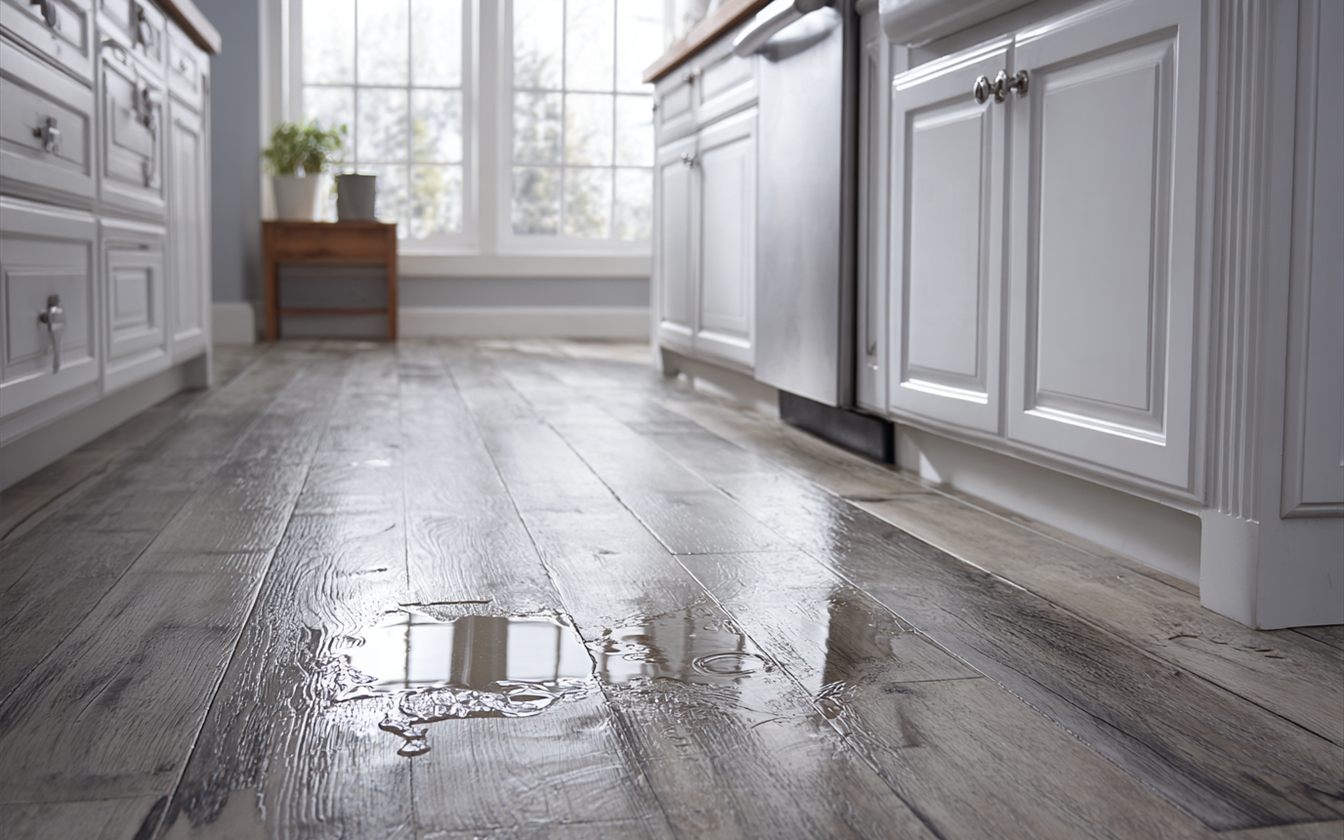
Floor Water Damage in Marysville Homes
Floors often show water damage before anything else does. Water from a dishwasher, a fridge line, a toilet or a washer runs under the flooring, where nobody sees it. The floor tells you by changing shape: seams lift, boards cup or crown, vinyl plank separates, a soft spot appears near a cabinet. Many of Marysville's newer homes have laminate or vinyl plank laid over a wood subfloor and a crawlspace. That makes it important to find out how far the water went under the floor, not just across it.
Signs the Water Got Under the Floor
- Peaked or swollen seams on laminate, where the fiberboard core has soaked up water at the edges
- Cupping, where hardwood boards' edges rise higher than their centers, usually from moisture below
- Crowning, the opposite, often after a cupped floor dried too fast or was sanded while wet
- Planks that separate or click apart, common with vinyl plank over a wet subfloor
- A soft or bouncy spot, which can mean the subfloor itself is wet or weakened
- Grout that darkens and stays dark around tile, or tiles that sound hollow when tapped
- A damp smell near the floor, or carpet that stays cool and damp in one area
Laminate, Vinyl Plank, Hardwood and Carpet
Each flooring type reacts to water in its own way.
| Floor | What water does | What usually happens |
|---|---|---|
| Laminate | The fiberboard core swells, and the seams lift | Swollen boards rarely flatten; affected rows are usually replaced after the subfloor dries |
| Vinyl plank (LVP) | The planks themselves resist water, but water gets underneath through seams and edges | Planks are often lifted so the subfloor can dry, and some can be reinstalled |
| Hardwood | Boards absorb water and cup or buckle | Sometimes dried in place with special mats; badly buckled boards are replaced |
| Carpet | Carpet and pad soak it up | Pad usually replaced; carpet may be dried and relaid if the water was clean and caught early |
| Tile | Tile is fine; grout and the underlayment can hold water | Often dried in place; loose tiles get reset |
After the floor is back down, check it properly: moving back in after a water job.
The Subfloor and the Crawlspace
The flooring you walk on is only the top layer. Underneath is a subfloor, usually plywood or OSB on newer homes, sitting on joists over a crawlspace or on a concrete slab. Water that gets under laminate or plank often soaks into the subfloor. OSB in particular swells and can lose strength if it stays wet. From there, water can drip into the crawlspace and soak the insulation between the joists.
That's why a careful company checks from below as well as above. Wet insulation in a crawlspace holds water against the subfloor, and it won't dry on its own in winter. Drying a floor properly can mean lifting the flooring, drying the subfloor with air movers, and drying the crawlspace with equipment under the house. On a slab, it means drying the concrete and checking it with a meter before anything new goes down.
What Changes the Size of a Floor Job
- How many rooms the water reached. Floating floors run continuously under walls and doorways, so water in the kitchen can reach the hallway.
- The flooring type. Laminate usually means replacement. Some vinyl plank and hardwood can be saved.
- The subfloor. Plywood often dries; badly swollen OSB may need replacing.
- Matching. If the flooring runs through several rooms, matching a discontinued product can mean replacing more than the wet area.
- The crawlspace. Wet insulation and a wet vapor barrier add removal and drying time.
- Cabinets and appliances. Flooring installed under cabinets is harder to dry and to replace.
Before the Company Arrives
Shut off the water if a supply line or appliance is the cause. Get towels or a wet vacuum on any water you can see, and move rugs and furniture off the wet area. Don't pull up flooring yourself to look, and don't run a heater on it to "dry it out." Fast heat on a wet wood floor can make it crown or crack. Take photos of the floor and the source, and write down when you first noticed it.
Cabinets, Islands and Appliances on a Wet Floor
Kitchens are where floors and water meet most often, and they're also where floors are hardest to get at. In many newer homes the flooring runs under the cabinets, or stops at them with the toe kick sitting on top. Water from a dishwasher or a sink line soaks in under the cabinet bases, where nobody can see it. Particleboard cabinet floors swell and crumble, and the space under the toe kick stays wet. A company will often pull the toe kicks to get air under the cabinets. It may move the fridge and the range so the flooring around them can be checked. Islands are their own question. If the floor runs under one, drying or replacing that section can mean lifting the island. None of this shows up on the surface, so it's worth asking how the company plans to dry under the cabinets, not just the open floor.
Will Laminate Go Back Down Flat Once It Dries?
Usually not. Once the fiberboard core has swollen, it doesn't shrink back to its original shape, and the seams stay raised. The usual fix is to dry the subfloor and replace the affected boards. If there's extra flooring from the original installation, that makes matching easier.
My Floor Feels Fine but Smells Damp. Should I Worry?
Possibly. A damp smell near the floor can mean water under it or in the crawlspace, even when the surface looks and feels normal. A moisture meter will show whether the subfloor or the crawlspace is wet. If it is, catching it early keeps the job small.
Floor Calls Around Marysville
Down by the slough
Up on the plateau
Smokey Point and Lakewood
North along the Stillaguamish
- ArlingtonNorth county
- SilvanaNorth county
- StanwoodNorth county
- Warm BeachWest of I-5
- Lake GoodwinWest of I-5
East toward the foothills
- Lake StevensToward the foothills
- Granite FallsToward the foothills
- MachiasToward the foothills
- SnohomishToward the foothills
Water standing under the house? See crawlspaces on the lowland.